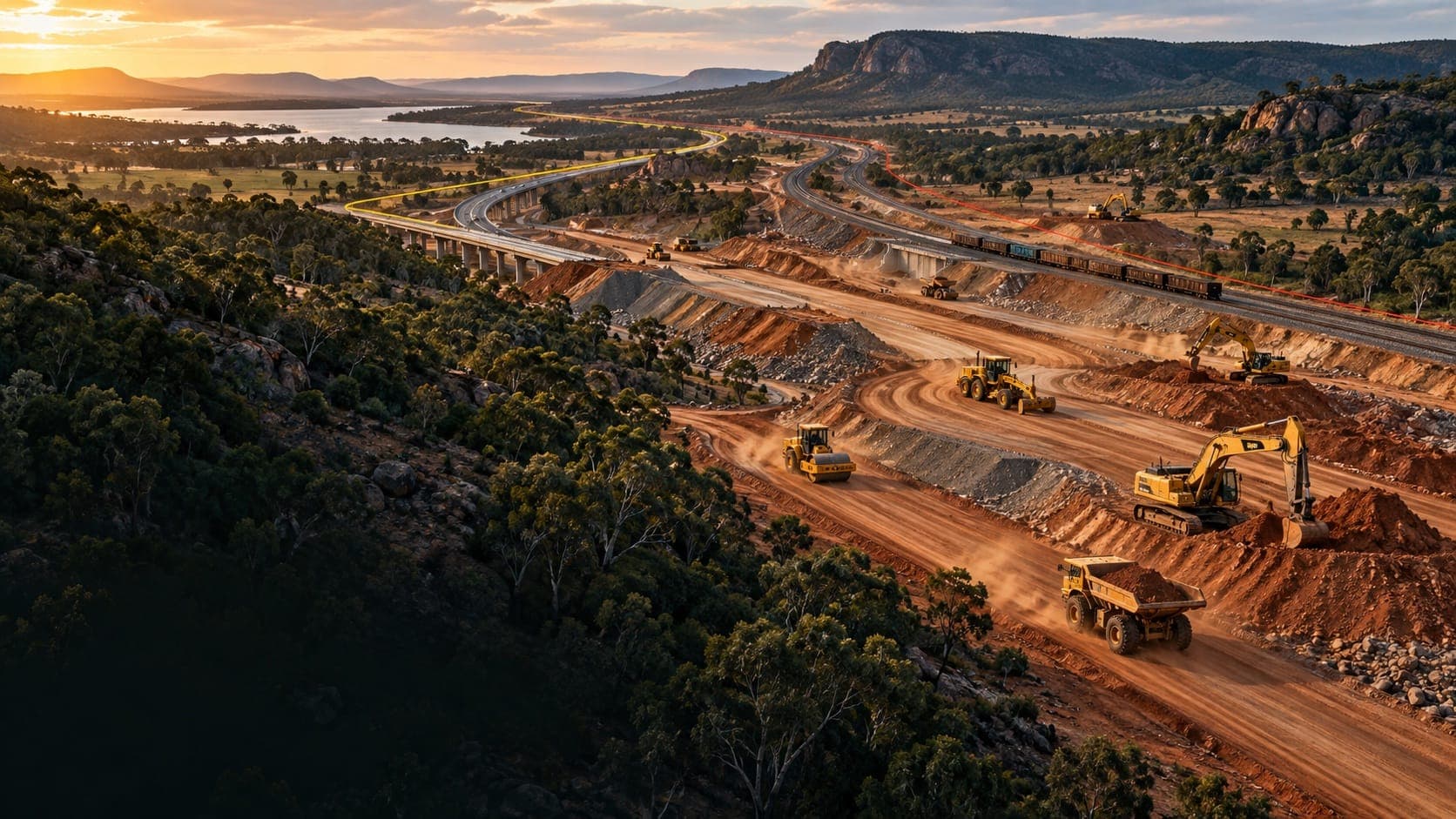
Road and rail projects put plant into live corridors where traffic, trains and the public are never far away. This guide covers the specialised machines used on transport infrastructure, the access and safety systems suppliers must work within, and the commercial realities of possession-based and night-shift work.
01 / Road construction and maintenance plant
Road projects combine civil earthworks fleets with pavement specialists. Excavators, graders, rollers and water carts form and compact the subgrade and base layers, while profilers or cold planers remove existing asphalt. Asphalt pavers, pneumatic tyred rollers and steel drum rollers lay and compact new surfaces, and stabilisers mix lime or cement into existing pavements for in-situ recycling. Asphalt and stabilisation plant is usually supplied with experienced crews because output and quality depend heavily on operator skill.
Maintenance and upgrade work adds lighter, highly mobile plant. Truck-mounted attenuators protect crews working behind them, vacuum trucks expose services within the road reserve, and backhoes or small excavators tackle drainage and kerb work. Variable message signs, lighting towers and traffic control equipment are often supplied through the same hire channels and are subject to the same inspection expectations as heavier plant.
02 / Rail plant and track access
Rail work relies on road-rail vehicles, typically excavators or trucks fitted with rail wheels that let them travel on track and on road. These machines carry out sleeper replacement, ballast work, drainage and overhead wiring tasks. Ballast regulators, tampers and sleeper handlers are usually operated by specialist rail contractors rather than general plant hire companies. General hire companies more often supply the road-rail excavators, trucks and support plant that work alongside that specialist track machinery.
Every rail network operator in Australia sets its own requirements for plant that goes on track. Machines usually need certification or registration with the network before use, covering items such as braking, rail wheel condition, load charts and slew or height limiting. Operators and track protection personnel need network-specific competencies. Confirm the current requirements with the relevant rail infrastructure manager, because they differ between networks and change over time.
03 / Working in live corridors
Road works are governed by traffic management plans prepared to the relevant state road authority's requirements, and plant movements must fit within them. Delivery of machines to a work zone, their parking outside work hours and entry and exit points all need to be planned. Night works are common on busy roads, which brings lighting, noise and fatigue considerations for hired operators.
Rail work typically happens within possessions, where a section of track is closed for a defined period. Possessions are planned months in advance and cannot be extended easily, so any plant failure during a shutdown has an outsized impact. Suppliers should expect to provide standby or backup machines, carry critical spares and have technicians available for the full duration of a major possession.
04 / Prequalification with road and rail clients
State road agencies and rail operators often maintain their own contractor prequalification schemes, and the principal contractors delivering their projects add further requirements. Plant suppliers may be asked for documented quality, safety and environmental systems, evidence of plant certification, and records showing operators hold the necessary competencies. Some schemes are tiered by value or risk. A supplier's tier may limit the size or type of work it can undertake without further assessment.
Suppliers working across several networks need a disciplined approach to certification records, because a machine accepted on one network may not be accepted on another without further inspection. Keeping an up-to-date matrix of each machine's registrations, expiry dates and network approvals lets a supplier respond quickly when a principal contractor requests plant at short notice. The same matrix should record operator competencies so that machine and operator approvals can be matched for each shift.
05 / Commercial realities of transport work
Night shifts, weekend possessions and short work windows mean plant may be productive for only part of a hire period. Agreements should address shift loadings, minimum call-out periods and how cancelled possessions are charged. A possession cancelled at short notice by the network can leave a supplier with idle machines and operators, and the contract should state who carries that cost.
For long corridor projects, suppliers may be asked to hold plant on site for extended periods with reduced standby rates between active shifts. Hirers should compare quotes on the total expected cost across the program rather than the headline hourly rate. Transport costs between staging areas along a long alignment are another item that is easily missed at tender. Asking suppliers to price a defined number of relocations gives a clearer basis for comparing offers.
Field checklist
- Confirm rail network plant certification requirements before quoting road-rail machines
- Check operator and track protection competencies for the specific network
- Align plant delivery and parking with the approved traffic management plan
- Plan backup machines and critical spares for major possessions
- Agree charges for cancelled possessions and short-notice shift changes
- Maintain a register of each machine's network approvals and expiry dates
Frequently asked questions
What is a road-rail vehicle?
A road-rail vehicle is a machine, commonly an excavator or truck, fitted with retractable rail wheels so it can travel on both road and track. They are used for maintenance, construction and inspection on rail corridors. They must usually be certified or registered with the rail network operator before use, and operated by personnel holding network-specific competencies.
Can any excavator be used on a rail project?
Standard excavators can often work in the rail corridor off track, subject to the network's safety rules and exclusion zones. Machines working on track generally must be road-rail vehicles certified for that network. Rules differ between rail infrastructure managers, so confirm the requirements for the specific corridor before assuming a machine is suitable.
What is a rail possession and why does it matter for plant hire?
A possession is a planned closure of a section of track so work can be carried out safely. Possessions have fixed start and end times and are hard to extend, so plant breakdowns during them are costly. Hirers often require suppliers to provide backup machines, spares and technicians on standby for the duration.
How are night works charged in plant hire?
Suppliers commonly apply shift loadings for night or weekend work, particularly for operated hire where labour costs rise outside standard hours. Some also set minimum hours per shift. Charges vary between suppliers and awards, so ask for night and weekend rates explicitly when requesting quotes for road or rail work.