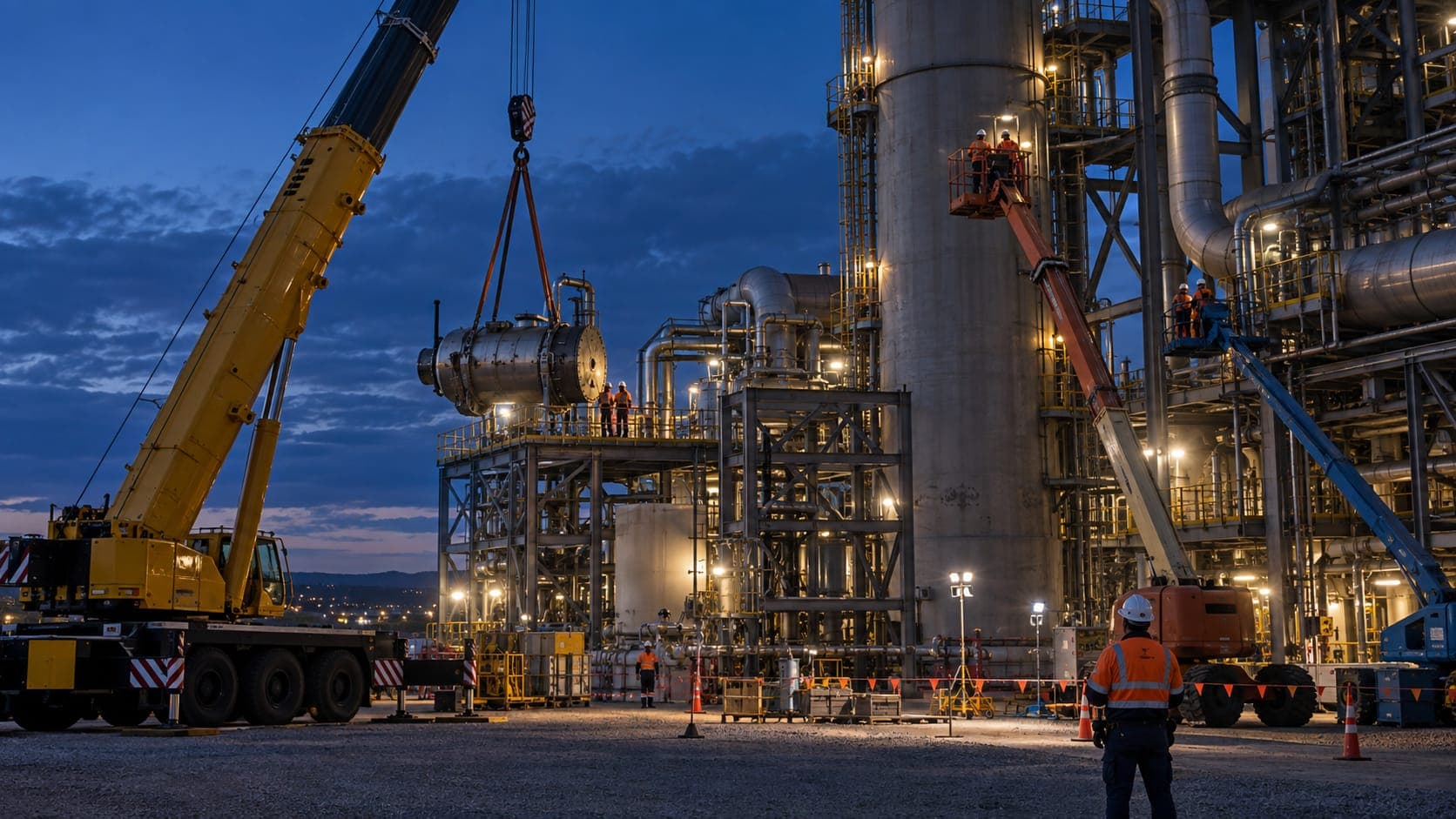
Planned shutdowns at refineries, smelters, power stations, processing plants and factories compress weeks of maintenance into a fixed window where every hour of delay carries a cost. Hiring plant for a shutdown is therefore about certainty: the right units, cleared for site entry and ready to work before the plant goes offline.
01 / Plant commonly needed during shutdowns
Shutdown work leans heavily on lifting and access. Mobile cranes, franna cranes and crawler cranes remove and replace heavy components such as motors, gearboxes, heat exchanger bundles and vessel internals. EWPs, including scissor lifts and knuckle and straight booms, provide access to pipework, ducts and structures where scaffolding would take too long to erect and dismantle. Telehandlers, forklifts and small mobile cranes keep materials and spares moving between laydown areas and work fronts.
The support fleet is broad. Temporary power generators, air compressors for tools and blasting, welding machines, lighting towers for night shifts, ventilation fans for confined space entry, and vacuum or hydro-excavation trucks for cleaning tanks, sumps and drains are all common. Crib rooms, ablutions and tool containers may be needed for a much larger temporary workforce. Each item should be tied to the specific shutdown tasks it supports rather than ordered for the whole outage by default.
02 / Planning and scoping the hire
Shutdown planning usually starts many months before the outage, with a defined scope, schedule and critical path. Plant requirements should be extracted from that plan task by task, capturing lift weights, radii and heights, access heights, power loads and any hazardous area classification. Sharing this level of detail with suppliers lets them propose suitable units and flag risks early, such as ground bearing limits over buried services or clearance problems inside buildings and pipe racks.
Because shutdowns tend to cluster in the same seasons across an industrial region, availability of large cranes and specialist access equipment can tighten quickly. Lock in key items well ahead and ask suppliers to confirm the actual units allocated rather than a general class. Consider redundancy for critical-path items, such as a second crane or spare generator, because one failure can delay restart. The cost of standby plant is often modest compared with the cost of an extended outage.
03 / Site entry, hazardous areas and permits to work
Industrial sites commonly have strict plant entry requirements, including pre-entry inspections, current service and inspection records, and specific controls for plant entering hazardous areas. Cranes will need current periodic and major inspection documentation, and EWPs require logbooks and up-to-date inspection records. Obtain the site's plant entry standard and send it to suppliers at enquiry stage, so non-compliant units are screened out before an order is placed rather than at the security gate.
Work during a shutdown usually runs under a permit-to-work system covering isolations, hot work, confined space entry and work at height. Crane operators and operators of boom-type EWPs above certain heights need the appropriate high-risk work licences, and everyone must complete site inductions. For hazardous area work, confirm whether standard diesel plant is allowed at all or whether electric or specially protected equipment is required, because that decision can reshape the plant list.
04 / Mobilisation and on-site logistics
Shutdown sites become congested, with many contractors, laydown areas and temporary facilities competing for limited space. Agree delivery times and routes with the site, as some facilities restrict heavy vehicle movements or require escorts inside the fence. Crane set-up positions need ground bearing assessment, particularly over underground services, trenches or old slabs. Mobilising critical plant a day or two before the outage begins leaves time for inspection, set-up and any rectification.
Refuelling, servicing and breakdown response during the outage should be planned rather than improvised. For round-the-clock shutdowns, ask whether the supplier can station a technician on site or guarantee a response time, and confirm who refuels plant and how fuel is controlled within the site. Maintain a live register of every hired item, its location, hire start date and responsible supervisor, which makes off-hiring efficient when scopes begin to close out.
05 / Commercial considerations for shutdown hire
Shutdown hire often involves minimum hire periods, loadings for nights and weekends, and premium rates for short-notice bookings. Clarify whether rates are per shift, per day or per hour, and how overtime is charged for wet hire when twelve-hour shifts stretch further. If the shutdown dates move, understand the cancellation and extension terms, especially for large cranes that may be committed to another outage immediately after yours.
A frequent and avoidable cost is plant left on hire after its scope has finished simply because nobody off-hired it. Assign responsibility for off-hiring each item and notify the supplier promptly and in writing. Industrial environments can expose plant to chemicals, fine dust, heat and abrasive blasting media, so agree how contamination and cleaning will be assessed. A joint inspection with the supplier's representative at collection is often the quickest way to settle condition questions.
Field checklist
- Extract plant requirements task by task from the shutdown schedule.
- Send the site's plant entry standard to suppliers with the enquiry.
- Confirm hazardous area requirements before selecting diesel plant.
- Lock in cranes and specialist EWPs early and confirm the actual units allocated.
- Arrange redundancy for critical-path plant such as cranes and generators.
- Pre-mobilise critical items for inspection before the outage starts.
- Assign responsibility for off-hiring each item as scopes finish.
Frequently asked questions
How early should I book cranes for a shutdown?
As early as practical, especially for large cranes or when several shutdowns in the region fall in the same period. Once the scope and lift requirements are defined, approach suppliers to confirm availability and allocate specific units. Ask about cancellation and extension terms at the same time, because shutdown dates frequently move as operational priorities change.
Can diesel equipment be used in hazardous areas?
Only if it meets the site's requirements for the classified zone. Standard diesel plant can be an ignition source, so hazardous areas may require specially protected equipment or an alternative power source. The site's hazardous area classification and plant entry standard set the rules. Discuss them with the supplier before hire so that suitable equipment is supplied from the start.
What documentation do cranes need for a shutdown site?
Sites commonly ask for the crane's registration, current periodic inspection records, logbook, load charts, maintenance history and the operator's high-risk work licence. Many also require a lift plan for each lift and evidence of major inspections for older cranes. Check the site's plant entry standard and give the supplier enough notice to provide the documents before mobilisation.
How can I avoid paying for idle plant after a shutdown?
Keep an up-to-date register of every hired item, including location and responsible supervisor, and off-hire each item as soon as its scope is complete. Notify the supplier in writing and record the off-hire time. Reviewing the register daily during the wind-down phase catches items that are no longer needed but would otherwise stay on charge.