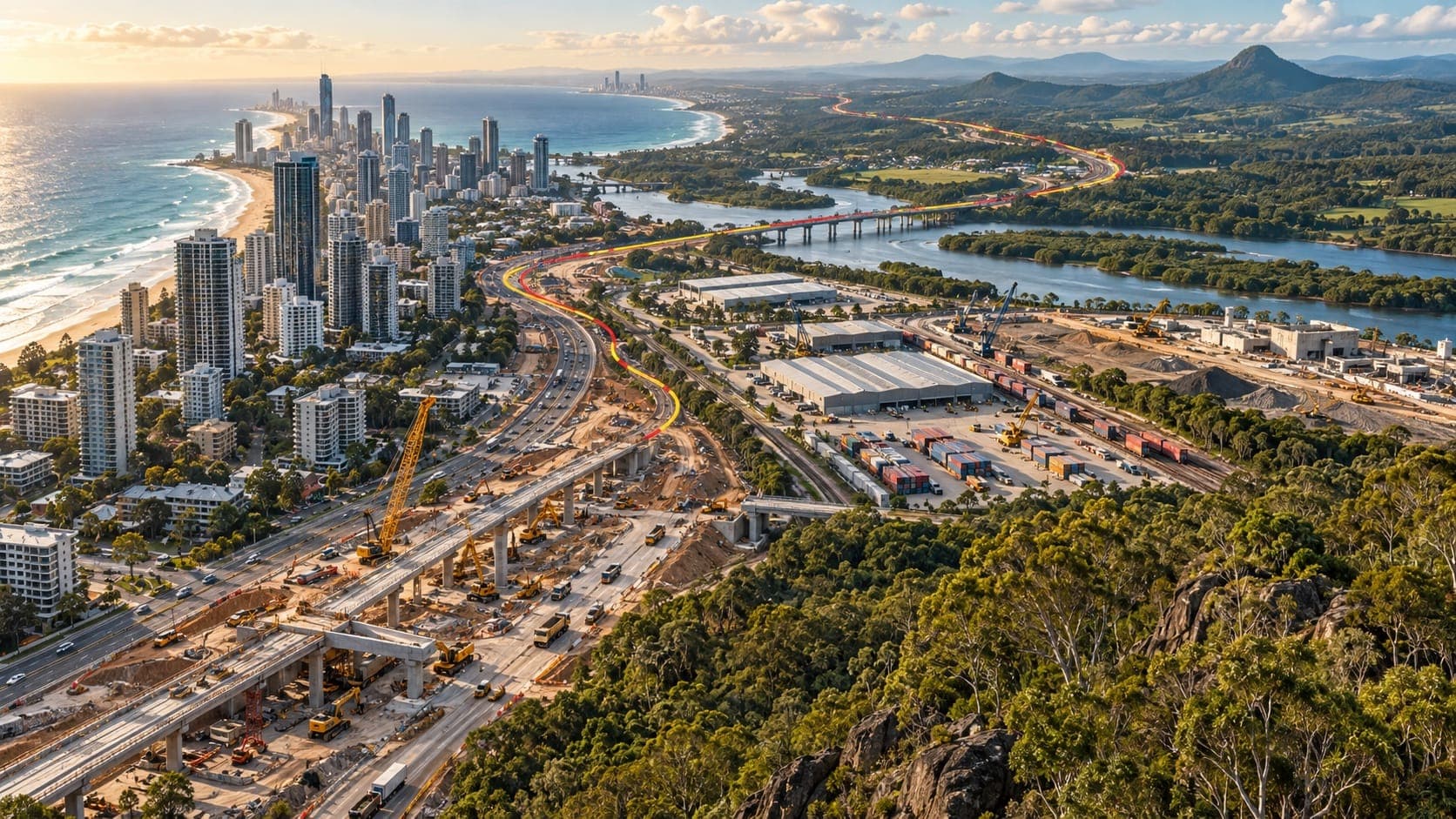
Road, rail and bridge packages run on tightly sequenced fleets, booked possessions or traffic windows, and mobilisation that has to land on the right night. This guide covers the plant mix, scoping approach and supplier questions that matter when you are hiring for a transport corridor package.
01 / The core fleet on a corridor package
Most corridor packages draw on a predictable spine of plant: 20 to 30 tonne excavators for bulk cut and drainage, articulated dump trucks or truck and dog combinations for haul, dozers for spreading and trimming fill, graders for subgrade and pavement shaping, and smooth drum and padfoot rollers for compaction. Water carts are almost always needed for moisture conditioning and dust control. Around that spine sits a support layer of lighting towers, variable message boards, truck-mounted attenuators, generators and amenities that is easy to under-scope when attention is on production machines.
Bridge and structure elements add lifting capability: franna-style pick and carry cranes for lighter precast and formwork, crawler or all-terrain cranes for girders and beams, and boom-type EWPs for bearing, deck and barrier work. Rail interfaces bring their own category, including road-rail excavators and other track-rated plant that must satisfy the rail infrastructure manager's acceptance process. Confirm early whether plant working in or near the rail corridor needs specific certification or network registration, because that requirement can narrow the pool of eligible suppliers very quickly.
02 / Scoping around possessions and traffic windows
On live corridors the binding constraint is usually access time rather than machine hours. Rail possessions and major road closures are booked well ahead, and a machine that arrives late or breaks down inside a possession can cost a shift that may not be rebooked for weeks. Treat each possession or closure as its own small programme, listing the plant required, the arrival time at the staging area, the fallback unit if something fails, and the person accountable for getting everything through the gate on time.
For road works under traffic, the approved traffic guidance scheme often dictates what plant can operate, where it can stand and how it enters and leaves the work zone. Night works shift the emphasis to lighting towers aimed away from oncoming drivers, reversing cameras, amber beacons and operators who are comfortable working beside live lanes. Build those requirements into the hire request itself, so suppliers quote compliant units rather than whatever happens to be available in the yard that week.
03 / Mobilisation, oversize transport and moves along the alignment
Larger dozers, excavators above roughly 30 tonnes, crawler cranes and some rollers exceed general access dimensions or mass limits once loaded, and must travel under the Heavy Vehicle National Law. Depending on the combination and the route, that can mean an NHVR permit, pilot or escort vehicles and restricted travel times. Ask each supplier who arranges permits and escorts and how much lead time they usually need. On many corridor jobs, permit timing sets the real mobilisation date more firmly than machine availability does.
Corridors are linear, so plant often relocates along the alignment rather than arriving once and staying put. Clarify whether moves between work fronts are priced as separate float movements, and whether tracked machines may walk within the corridor or on adjoining public roads. Nominating laydown and float loading areas at each work front, with safe access off the live carriageway, saves time on every move and removes a frequent source of argument over who pays for internal relocations.
04 / Compliance expectations on major infrastructure
Tier-1 contractors and state road and rail authorities generally expect plant to arrive with a documented pre-mobilisation inspection, current service records, a plant risk assessment and operator competencies that match their site rules. Many major projects then run their own plant verification before a machine is permitted to start. Ask the supplier for their standard plant pack in advance and compare it line by line with the principal contractor's checklist, so any gaps are closed in the yard rather than discovered at the site gate.
Safety-critical fit-out varies between projects but commonly includes proximity or collision awareness systems, reversing cameras, seatbelt interlocks and specific controls for plant working near overhead powerlines or rail traction equipment. Environmental conditions may add spill kits, drip trays and noise limits near homes. Operators will usually need to complete project inductions and work under a SWMS for high-risk construction work, so allow for induction lead times in the mobilisation plan rather than assuming operators can start on arrival.
05 / Commercial traps in corridor hire agreements
The most common disputes on corridor jobs involve standby, minimum hours and damage. If a possession is cancelled or a closure is withdrawn at short notice, find out beforehand whether the machine is charged at standby, full rate or nothing at all. Minimum daily or weekly periods can inflate the cost of short night shifts, so check whether a four-hour closure attracts an eight-hour minimum. Record the agreed position in writing rather than relying on how the previous job happened to be handled.
Wet hire with an operator shifts some risk to the supplier but raises questions about fatigue management, travel time and who pays overtime when a shift overruns. Dry hire places maintenance, damage and misuse risk more heavily on the hirer. Read the damage waiver exclusions closely, particularly for undercarriage wear, tyre damage from milled or broken surfaces and glass breakage. Also settle how fuel is charged, since corridor plant is often refuelled from mobile tankers rather than returned to a depot each night.
Field checklist
- Map every possession or road closure and list the plant, arrival time and backup unit for each.
- Confirm which items need NHVR permits or escorts and who is arranging them.
- Request each supplier's plant pack and compare it with the principal contractor's verification checklist.
- Specify night-works equipment such as lighting towers, beacons and reversing cameras in the hire request.
- Agree standby, cancellation and minimum-hours terms in writing before mobilisation.
- Nominate laydown and float loading points along the alignment.
- Check rail-corridor plant certification requirements with the infrastructure manager early.
Frequently asked questions
What plant is typically hired for a road corridor upgrade?
A typical road upgrade uses 20 to 30 tonne excavators, dozers, graders, padfoot and smooth drum rollers, water carts and tipper or articulated haulage. Support plant such as lighting towers, message boards, generators and traffic management vehicles is usually needed as well. Bridge or structure elements add cranes and EWPs. The exact mix depends on earthworks volumes, the pavement design and the traffic staging approved for the project.
Do I need a permit to move a large excavator to a corridor site?
It depends on the combined dimensions and mass of the machine and the float. Smaller excavators on a suitable trailer often travel without a permit, while larger machines may exceed general access limits and need an NHVR permit, and possibly escorts or travel-time restrictions. Your transport provider should confirm the requirement for the specific combination and route, and you should allow lead time because permits are not always issued immediately.
What happens if a rail possession is cancelled after plant is booked?
That depends entirely on the hire agreement. Some suppliers charge a cancellation fee or standby rate, others charge the full minimum hire, and some waive charges if given enough notice. Because possession changes are common, negotiate a cancellation clause before confirming the booking, covering notice periods and how charges apply to transport already dispatched. Written terms avoid disputes after the event.
Is wet hire or dry hire better for corridor works?
Wet hire with an experienced operator suits short, high-consequence windows such as night closures or rail possessions, because the supplier provides someone who already knows the machine. Dry hire can be more economical for long-running production work where your own inducted crews are competent on the equipment. Weigh fatigue management, induction lead times and who carries damage risk before choosing, rather than comparing hourly rates alone.