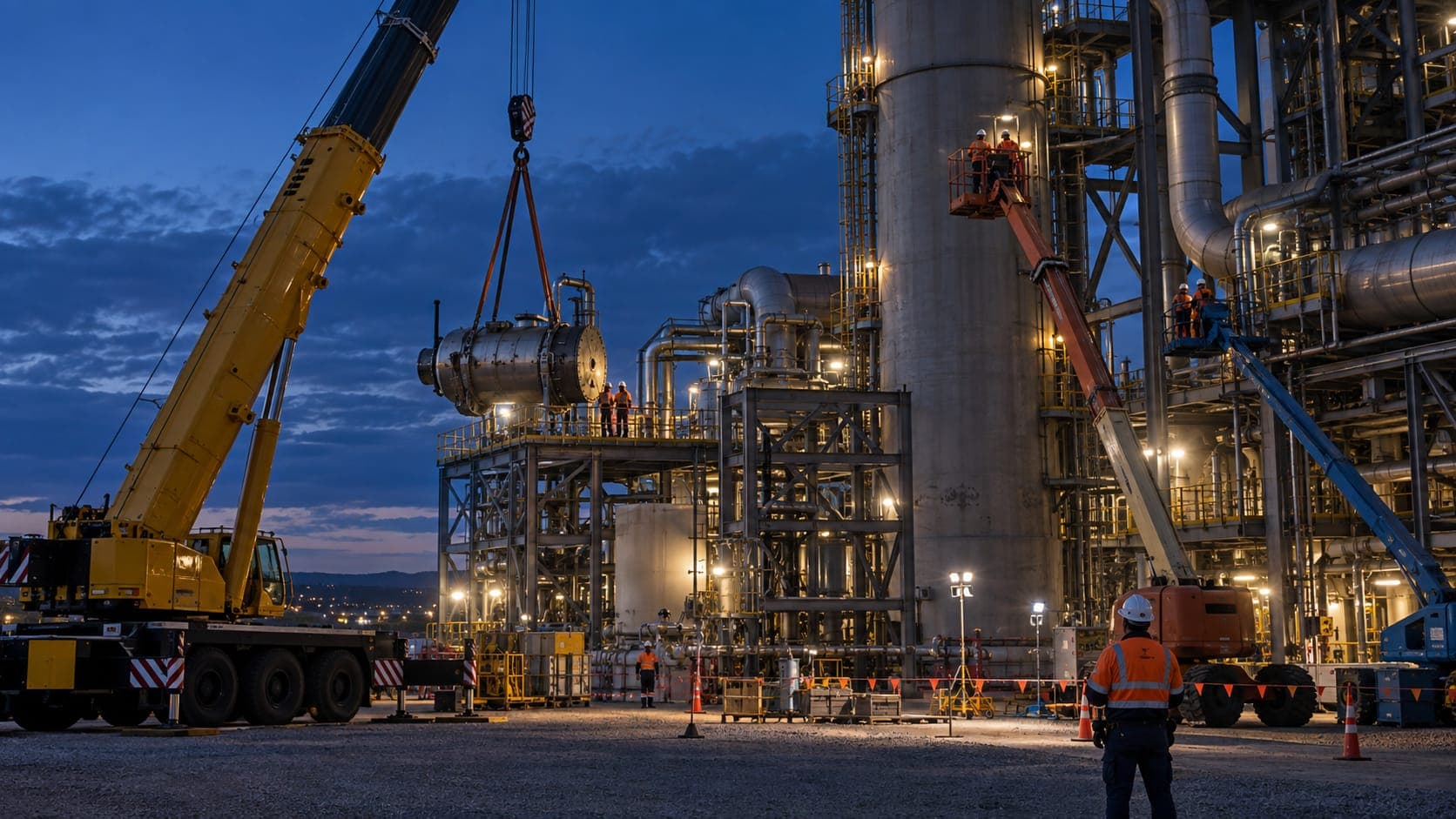
Mobilisation is the cost of getting plant to site and ready to work, and demobilisation is the cost of taking it away again. On short hires these charges can rival the hire itself, and they are among the most common sources of invoice disputes. This guide explains the usual components and how to ask for them in a form you can check.
01 / What mobilisation and demobilisation cover
Mobilisation typically covers loading the machine at the depot, transport to site, unloading and any set-up needed before it can work. Demobilisation is the reverse. For simple plant this might be a single tilt-tray or float movement each way. For cranes, larger excavators or specialised equipment, it can involve multiple loads, counterweights travelling separately, assembly crews and a period of commissioning before the machine is available for work.
Suppliers price these movements in different ways. Some quote a fixed lump sum each way, some charge an hourly transport rate from depot back to depot, and some combine a base charge with distance or time components. None of these approaches is inherently better, but they behave differently if the job location, access or timing changes, so ask how the charge is calculated as well as what it totals.
02 / Float and transport charges
The transport vehicle is chosen to suit the machine's weight and dimensions. Smaller plant may travel on a tilt-tray or tag trailer, while larger machines need a low loader or float. The hourly or per-trip cost depends on that configuration, and heavier combinations may be limited to approved routes. Waiting time on site, for example while a gate is opened or a laydown area cleared, is often charged at the transport rate.
Ask whether the transport quote assumes the float can reach the unloading point directly, and what happens if it cannot. A site that requires the machine to be unloaded at the street and walked in may need traffic control, ground protection or a different time of day. Where several machines are arriving, ask whether loads can be combined, and whether return transport is quoted at the same rate or subject to availability at the time.
03 / Permits, pilots and escorts
Oversize or overmass loads may need permits from the relevant road authority or the National Heavy Vehicle Regulator, depending on the vehicle, route and state. Some movements also require pilot vehicles or escorts, and in certain circumstances police escorts, along with restrictions on travel times such as daylight-only or off-peak movement. These requirements are set by the relevant authorities, and the rules differ between jurisdictions.
Permit fees, application time, pilot vehicles and any restrictions on travel windows are usually passed on to the hirer. They can also affect timing, because a load that may only travel at certain hours may arrive a day later than a standard delivery. Ask suppliers to state whether their quote includes permits and escorts, how long approvals typically take for your route, and who bears the cost if the permitted route changes.
04 / Travel, accommodation and allowances
Where wet hire involves an operator travelling beyond the supplier's normal area, expect charges for travel time and, for longer distances, accommodation and meals. Some suppliers charge travel time at the operator's normal rate, others at a reduced travel rate, and some include a set radius free of charge. Clarify whether daily travel from a nearby town is charged, or whether the operator is expected to stay close to site.
Assembly crews for cranes or large plant, fitters attending breakdowns and supervisors attending set-up may also attract travel and accommodation charges. On longer regional hires, ask whether the operator will rotate out on a roster and how the replacement's travel is charged. Where you provide accommodation, such as in a camp, say so in the brief, because it can remove a significant cost from the quote and change the supplier's planning.
05 / Keeping mobilisation charges transparent
Ask every supplier to itemise mobilisation and demobilisation separately from the hire rate, and to list their assumptions: the depot the machine is coming from, the transport configuration, permit and escort requirements, and access to the unloading point. With those assumptions visible, you can check whether a price difference reflects a genuine advantage, such as a closer depot, or simply a different reading of the site.
Before accepting, confirm whether demobilisation is fixed or will be recalculated at the end of the hire, and whether an early off-hire changes it. Record the delivery and collection details in the docket, including times of arrival and departure, so that any waiting time is supported by evidence. If a supplier later seeks additional charges, those records are the practical basis for resolving the question.
Field checklist
- Ask for mobilisation and demobilisation itemised separately from the hire rate
- Confirm the dispatch depot and the transport configuration assumed
- Check whether permits, pilots or escorts are needed and who pays for them
- Confirm whether the float can reach the unloading point directly
- Clarify travel time, accommodation and meal allowances for operators and crews
- Ask whether demobilisation is fixed or recalculated at off-hire
- Record arrival and departure times on delivery and collection dockets
Frequently asked questions
What does mobilisation mean in plant hire?
Mobilisation is the process and cost of getting a machine from the supplier's depot to your site and ready for work, including loading, transport, unloading and any set-up. Demobilisation is the equivalent process at the end of the hire. Both are often charged separately from the hire rate and should be itemised in the quote.
Why are mobilisation costs so high on some quotes?
Costs rise with machine size, distance, transport configuration, permits, escorts, restricted travel windows, multiple loads and on-site assembly. A distant depot or difficult site access can also add significant time. Asking each supplier for their assumptions usually reveals whether a high figure reflects genuine constraints or a conservative reading of the brief.
Do I pay demobilisation if I off-hire early?
Generally yes, because the machine still has to be collected. Whether the charge changes depends on the hire agreement. Some suppliers quote a fixed demobilisation amount regardless of timing, while others calculate it at the time of collection. Confirm the position before accepting the quote, particularly for hires with uncertain duration.
Who arranges oversize permits for plant transport?
In most cases the transport provider or plant supplier arranges permits for oversize or overmass loads, with the cost passed on to the hirer. Requirements depend on the vehicle, load, route and jurisdiction. Ask the supplier to confirm whether permits and escorts are included in the quote and how long approvals are expected to take.