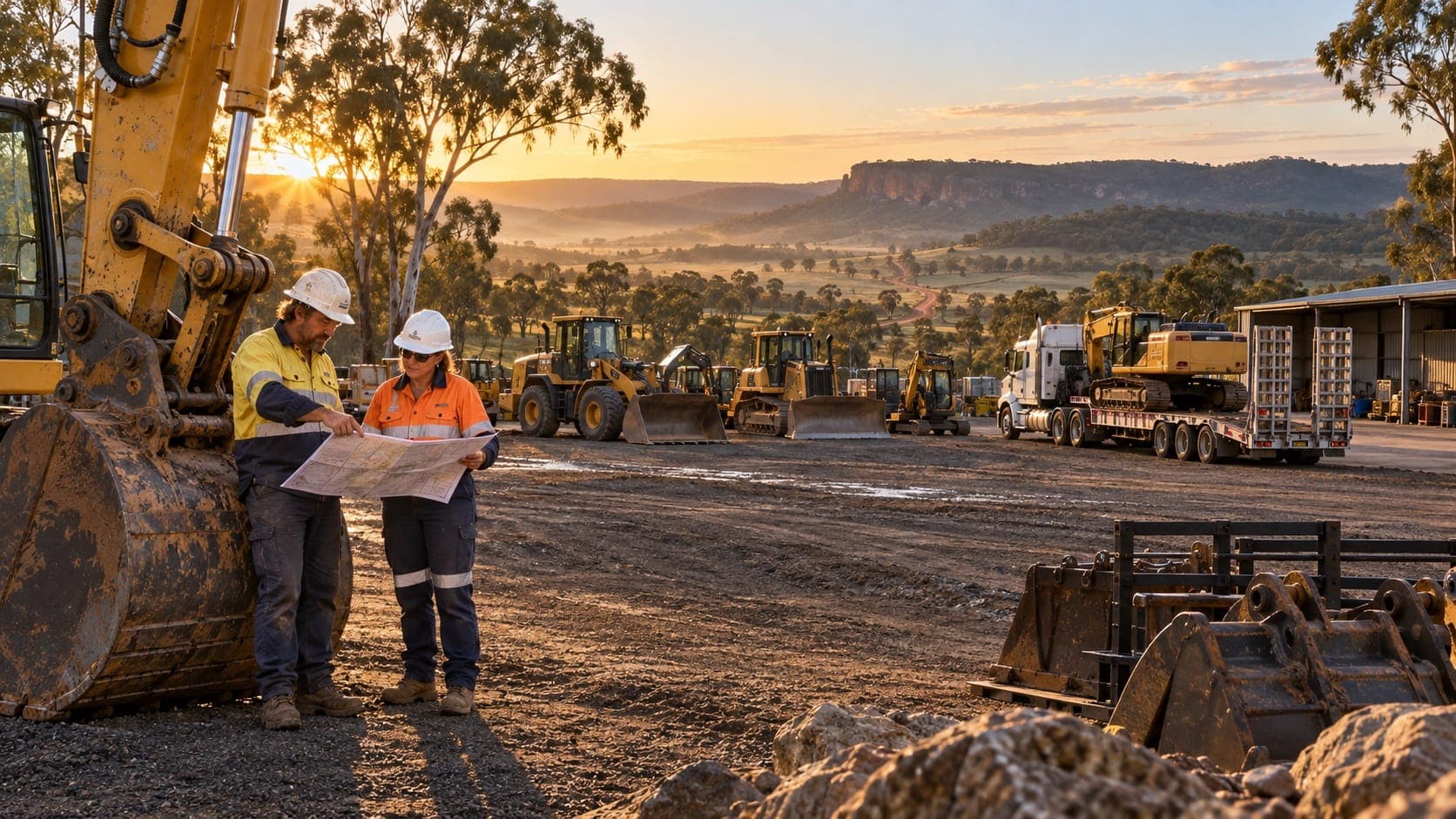
Trucks and Transport Hire decisions begin with the task, not the badge on the machine.
01 / Common truck types for construction hire
Tippers are the most frequently hired construction truck. Small tippers carry a few tonnes and suit landscaping and small builders, while rigid tippers (often six or eight wheelers) move spoil, fill and aggregate on civil jobs. Truck and dog combinations pair a tipper with a tipping trailer for larger volumes on longer haul routes. Semi tippers and side tippers are used for bulk material haulage in larger operations. Each carries different payloads and suits different access, so the volume and the site layout drive the choice.
Specialised trucks round out the category. Water carts supply dust suppression and moisture conditioning for compaction on earthworks and roadworks. Tilt trays and beaver tails move small plant, containers and site sheds. Crane trucks, sometimes called hiab trucks, deliver and position materials using a vehicle loading crane. Low loaders and floats transport excavators, dozers and other heavy plant. Service trucks with fuel tanks, lubricants and tools support machines on remote sites, and vacuum trucks handle non-destructive digging and liquid waste.
02 / Licence classes and operator requirements
Australian driver licence classes set which vehicles a driver may operate. A light rigid (LR) licence covers smaller trucks, a medium rigid (MR) licence covers two-axle trucks above that range, a heavy rigid (HR) licence covers rigid trucks with three or more axles, and heavy combination (HC) and multi-combination (MC) licences cover prime movers with trailers and larger combinations. Check the gross vehicle mass of the specific truck and the licence class required before arranging dry hire.
Crane trucks carry additional requirements. Operating a vehicle loading crane with a capacity of 10 metre-tonnes or more requires a high risk work licence, and slinging loads may require a dogging licence. For water carts and tippers on construction sites, drivers typically also need a construction induction and may be asked for site-specific competencies. Because of these requirements, many contractors wet hire trucks with an experienced driver rather than dry hire, particularly for heavy combinations and specialised vehicles.
03 / Load limits, compliance and the chain of responsibility
Heavy vehicles in Australia operate under mass, dimension and loading rules administered largely through the Heavy Vehicle National Law and the National Heavy Vehicle Regulator in participating jurisdictions, with Western Australia and the Northern Territory operating their own arrangements. Overloading can lead to penalties, and the chain of responsibility means that parties such as consignors, loaders and schedulers, not only drivers, may have legal obligations. If you are loading hired trucks, understand the payload and how your loading affects compliance.
Over-dimensional or heavy loads, including large excavators on floats, may need permits, route assessments, pilot or escort vehicles and travel restricted to certain times. Load restraint is another responsibility: materials, plant and site sheds must be secured according to the relevant load restraint guidance. When hiring a truck for a specific transport task, tell the supplier exactly what will be carried, including weight and dimensions, so they can plan permits and equipment. Guessing can lead to delays or a truck that cannot legally take the load.
04 / Planning site access and productivity
Trucks need room to enter, turn, load and tip safely. Check gate widths, overhead clearance, turning circles, ground strength and slopes before booking large tippers or truck and dog combinations. Soft ground can bog loaded trucks, and tipping on uneven ground raises rollover risk. Plan a traffic management layout on site to separate trucks from workers, with spotters where reversing is unavoidable. On public roads, a traffic management plan may be required when trucks enter and exit the site frequently.
Productivity depends on matching trucks to the loading machine and the tip site. Too few trucks leave an excavator idle; too many leave trucks queuing. Calculate the cycle time from loading, travel, tipping and return, and ask the supplier how many trucks are needed for your volume. Tipping fees at landfills or recycling facilities are often a significant cost, and contaminated soils or materials such as asbestos require specific handling, transport and disposal arrangements that must be planned in advance.
05 / Pricing, extras and choosing a transport supplier
Wet hire trucks are usually charged by the hour with minimum hire periods, while some haulage work is priced per load or per tonne. Clarify travel time to and from the depot, waiting time, overtime, tolls, and tip fees. Water carts may carry an additional charge for the water itself or the standpipe used to fill them. For dry hire, check fuel policies, kilometre allowances, damage excess, cleaning fees and whether road user charges or registration are included.
Good transport suppliers maintain current registration and roadworthiness, keep records of maintenance, and use drivers with the right licences and fatigue management practices. They advise on the right vehicle for the load rather than sending whatever is available, and they communicate clearly about arrival times and delays. For civil jobs requiring multiple trucks, check whether the supplier can provide a consistent fleet with drivers familiar with site rules, and whether they can scale up or down as the job changes.
Field checklist
- Confirm the material, volume and weight to be moved, and the haul distance.
- Check the licence class required for dry hire vehicles.
- Confirm high risk work licences for crane trucks of 10 metre-tonnes or more.
- Assess site access, turning space, ground strength and overhead clearance.
- Plan tip site location, fees and any contaminated material requirements.
- Ask about permits and escorts for over-dimensional loads.
- Clarify travel time, waiting time, minimum hours and tolls in the quote.
Frequently asked questions
What licence do I need to drive a hired tipper?
It depends on the truck's gross vehicle mass and axle configuration. Small tippers may be driven on a light rigid or medium rigid licence, while three-axle tippers generally require a heavy rigid licence. Truck and dog combinations require a heavy combination licence or higher. Check the specific vehicle's details with the supplier before booking.
What is a water cart used for on a construction site?
Water carts spray water to suppress dust on haul roads and work areas, and to bring fill and road base to the right moisture content for compaction. They are common on earthworks, roadworks and mine sites. Some water carts also have hoses and cannons for fire suppression support or cleaning. They are usually wet hired with a driver.
Is truck hire charged by the hour or by the load?
Both methods are common. Wet hire trucks are often charged hourly with a minimum hire period, while some haulage work is quoted per load or per tonne. Tip fees, tolls and waiting time may be charged separately. Ask the supplier which method they use and compare total costs based on your estimated volumes and cycle times.
Do I need a licence to operate a crane truck?
Operating a vehicle loading crane with a capacity of 10 metre-tonnes or more requires a high risk work licence, in addition to the appropriate driver licence for the truck itself. Smaller cranes still require training and competency. Slinging loads may require a dogging licence. Many crane truck hires include an experienced operator.