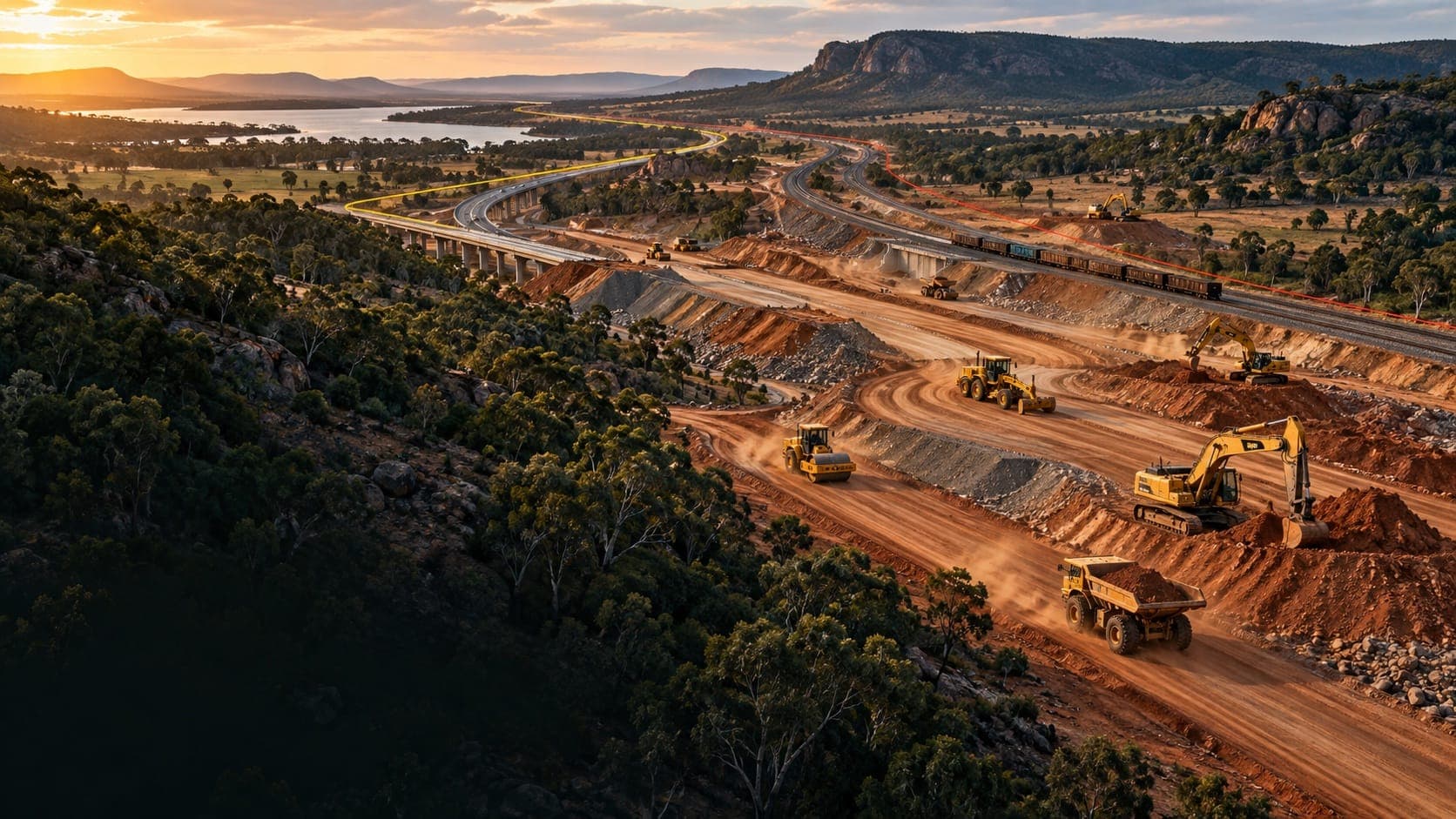
Earthmoving Equipment Hire decisions begin with the task, not the badge on the machine.
01 / The main machine classes and where they fit
Excavators are the backbone of most earthmoving hire fleets. Mini excavators in the 1.7–5 t range suit residential footings, service trenches, landscaping and tight side access, and many can be towed on a plant trailer. The 13–14 t class is the general-purpose civil machine for detailed excavation, pipe laying and larger house sites. Machines of 20–30 t handle bulk excavation, rock work with a hammer and loading trucks efficiently, while 30 t-plus excavators are used for mass earthworks, quarry faces and major infrastructure where production rate drives the cost.
Beyond excavators, the fleet broadens quickly. Dozers in the D6 class are common for clearing, spreading fill and dam construction, with D8-class machines reserved for heavy ripping and large-volume pushing. Skid steers and posi-tracks (tracked compact loaders) handle site clean-up, levelling and material shifting on small jobs. Wheel loaders stockpile and load trucks, backhoes combine digging and loading for councils and utilities, graders trim subgrade and maintain haul roads, and articulated dump trucks (ADTs) move material across soft or uneven ground where a road tipper would bog.
02 / Sizing the machine to the job and the site
Start with the constraints, not the machine. Measure the narrowest access point, check overhead powerlines and trees, and note slab edges, retaining walls or buried services near the work area. Zero-swing and reduced-tail-swing excavators exist precisely for work beside boundaries and buildings. Then consider dig depth and reach: a mini excavator may reach two to three metres depending on arm configuration, which is often enough for footings but not for deeper sewer connections or basement work. Confirm the published specifications for the exact model rather than relying on a class description.
Production matters on larger jobs. If the machine is loading trucks, match bucket size to the truck body so each tipper is filled in a sensible number of passes; a machine that is too small keeps trucks waiting and you pay for both. Ground conditions also count. Soft, wet clay favours tracked machines with wider shoes, while hard rock may justify stepping up a class so a hammer or ripper can work effectively. When in doubt, describe the task and volume to the supplier and ask them to recommend a class, then compare that advice across two or three quotes.
03 / Attachments that change what the machine can do
An excavator's usefulness depends heavily on what hangs off the quick hitch. Common options include general-purpose and trenching buckets in several widths, batter or mud buckets for shaping and cleaning, rock buckets, hydraulic hammers (rock breakers), rippers, augers for post holes and piers, grabs, and tilt hitches for precise grading. Posi-tracks and skid steers can run augers, trenchers, four-in-one buckets, pallet forks, broom sweepers and mulchers. Always confirm the machine has the hydraulic circuit and flow the attachment needs, particularly for mulchers and larger hammers.
Attachments are usually charged separately, and some suppliers charge a day rate whether the attachment is used or not once it is on site. Check whether the quick hitch is compatible with the buckets you plan to bring from your own fleet, since hitch patterns vary between manufacturers and sizes. Hammer hire often carries extra conditions, such as wear charges on the tool point or a requirement that the operator greases it at set intervals. List every attachment you think you will need in the enquiry so the supplier can send them on the same float.
04 / Wet hire, dry hire and operator competency
Wet hire means the machine comes with an operator supplied by the hire company; dry hire means you provide the operator and take responsibility for how the machine is used. Wet hire is common for dozers, graders and larger excavators, where operator skill directly affects production and finish quality. Dry hire is popular with builders and landscapers who have experienced operators on staff and want a mini excavator or posi-track for a week or longer. Under dry hire you will generally carry more risk for damage, so read the damage waiver and insurance terms closely.
Earthmoving machines are not generally covered by the national high risk work licence scheme, but that does not mean anyone can operate them. Most principal contractors and many hire companies expect evidence of competency, such as nationally recognised units of competency for the specific machine type or a verification of competency assessment, along with general construction induction (White Card) training for construction sites. Mine sites and some civil clients apply stricter requirements of their own. Check what your site and your client require before assuming a dry hire operator is acceptable.
05 / Floats, transport and site delivery
Transport is frequently the largest cost on a short earthmoving hire. Mini excavators can often travel on a tag trailer or small tilt tray, but machines in the 13 t class and above normally need a float, and 30 t-plus excavators or D8-class dozers may be over-dimensional loads needing permits, pilot vehicles or restricted travel times. Floats are usually charged each way, often with a minimum charge, so a two-day hire in a regional area can cost more in transport than in machine time.
Check the site before the float arrives. The truck needs a safe place to unload, firm ground, room to manoeuvre and clearance from overhead lines. Driveways, kerbs and footpaths can be damaged by tracked machines, and councils may require a permit or protection when working from the road reserve. Tell the supplier about steep access, narrow streets or low bridges on the route. If the job has several stages, ask whether it is cheaper to keep the machine on standby than pay for two extra float movements.
06 / Quotes, hidden costs and choosing a supplier
A clear enquiry gets a comparable quote. State the machine class and attachments, wet or dry hire, site address and access limits, start date and expected duration, working hours, and the type of material. Then look beyond the hourly or daily rate. Common extras include minimum hire periods, float charges each way, fuel if the machine is not returned full, cleaning fees for machines returned caked in clay, damage waiver, attachment day rates, excess hours over a standard shift and wear charges on ground engaging tools and hammer points.
Good earthmoving suppliers are straightforward about what the machine can and cannot do. They supply recent service records or pre-start documentation on request, deliver machines with working safety features such as reversing alarms, beacons and seat belts, and respond quickly when something breaks down. For wet hire, ask about the operator's experience on similar jobs and whether a replacement operator is available if needed. A supplier with a local depot or service technician can make a large difference if a hydraulic hose fails mid-job.
Field checklist
- Measure the narrowest access point and check for overhead powerlines before choosing a machine class.
- Confirm dig depth, reach and tail swing from the model's published specifications.
- List every attachment needed, and confirm hydraulic flow and hitch compatibility.
- Decide on wet or dry hire and gather operator competency evidence for dry hire.
- Ask for float charges each way, permits for large machines and any minimum transport charge.
- Clarify fuel, cleaning, damage waiver and wear charges in writing before hire starts.
- Arrange a service locate before any digging near buried utilities.
Frequently asked questions
What size excavator do I need for a house slab?
For a typical residential slab with strip or pad footings, a 1.7–5 t mini excavator is usually enough, and a 5 t machine handles cut-and-fill and site levelling faster. Sloping blocks, rock, or large volumes of spoil may justify a 13–14 t excavator. Access is often the deciding factor, so check side-access width and whether a zero-swing machine is needed near boundaries.
Do I need a licence to operate a hired excavator?
Excavators are not generally among the classes covered by the high risk work licence scheme. However, hire companies and principal contractors commonly ask for evidence of competency, such as relevant units of competency or a verification of competency, plus general construction induction training for construction sites. Requirements differ between sites, clients and states, so confirm what your site requires before booking a dry hire.
What is the difference between a skid steer and a posi-track?
Both are compact loaders that use the same style of attachments. A skid steer runs on wheels and suits hard surfaces such as concrete or compacted base. A posi-track, or compact track loader, runs on rubber tracks, which spread its weight and give better traction in soft, wet or sandy ground, usually with less surface damage. Posi-tracks are often preferred for landscaping and site preparation.
Is it cheaper to wet hire or dry hire earthmoving equipment?
Dry hire has a lower machine rate because no operator is included, but you carry the operator cost, more damage risk and responsibility for productivity. Wet hire costs more per hour but brings an experienced operator who may finish sooner and with fewer mistakes. For short, specialised tasks such as dozer or grader work, wet hire is often better value overall.
How far in advance should I book earthmoving hire?
Mini excavators and posi-tracks are widely available and can often be booked with a few days' notice in metropolitan areas. Larger excavators, dozers, graders and ADTs may need more lead time, especially in regional areas or during periods of heavy civil activity. Booking early also gives the supplier time to plan float movements and any permits required for over-dimensional machines.