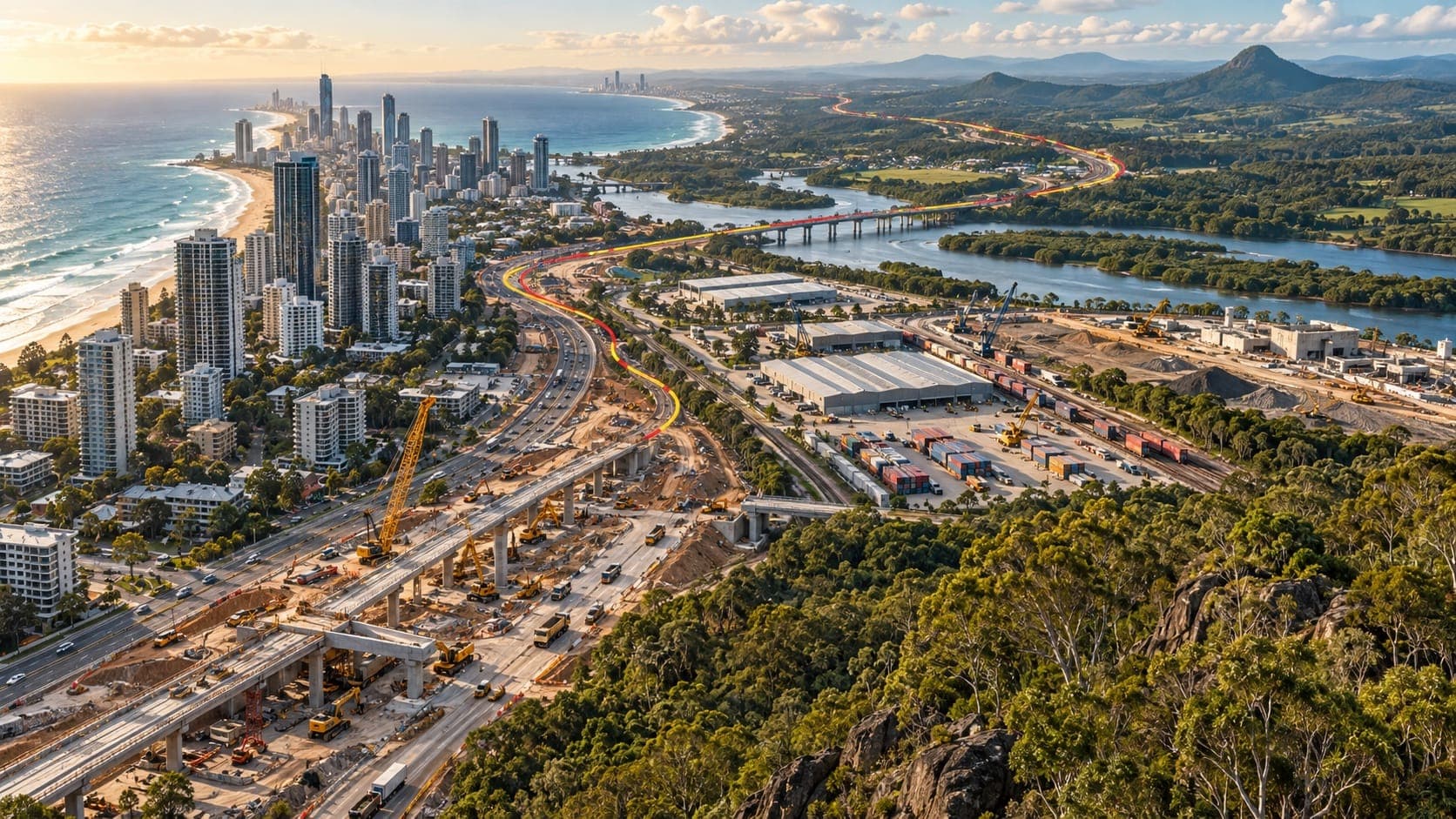
Queensland's plant hire market stretches along more than two thousand kilometres of coast and deep into mining and farming country. The south-east has the depth of supply, while regional hubs from Toowoomba to Cairns serve resources, agriculture and infrastructure work shaped by a tropical wet season.
01 / The south-east corner and a chain of coastal hubs
Brisbane, Ipswich, Logan, the Gold Coast and the Sunshine Coast together form the state's largest hire market, with major depots concentrated in industrial areas along the Brisbane River, around the Port of Brisbane and in the western corridor towards Ipswich. Most categories of plant are readily available here, and south-east yards often supply regional jobs when local fleets are stretched.
Up the coast, each major town supports its own contractor base. Rockhampton and Gladstone serve central Queensland's agriculture, port and heavy industry; Mackay is closely tied to the Bowen Basin coalfields; Townsville supports the north with a mix of defence, port, mining and infrastructure work; and Cairns services the far north, the Tablelands and Cape York. Inland, Toowoomba is the gateway to the Darling Downs and Surat Basin.
Remote areas such as the North West around Mount Isa, the Channel Country and Cape York rely on a thinner network of local operators, supplemented by machines trucked out from the coast when something larger or more specialised is needed. Expect longer lead times, fewer choices of make and model, and mobilisation charges that can rival the hire itself on shorter jobs in these regions.
02 / Resources, energy, agriculture and growth
Mining is central to regional demand. The Bowen Basin, with towns such as Moranbah and Emerald, uses large volumes of earthmoving plant, water carts, light towers and support equipment, while the Surat Basin around Roma, Chinchilla and Dalby has supported gas field development and associated civil work. Mine-site hire normally involves stricter equipment standards, inspections and inductions than general construction.
Energy work, including wind, solar and transmission construction across central and southern Queensland, draws on heavy haulage, cranes and civil fleets. Sugar cane districts from Bundaberg to the far north, grazing in the west and horticulture on the Downs and around Bowen create seasonal demand for tractors, loaders and irrigation-related earthworks. In the south-east, population growth keeps residential subdivision, road upgrades and building construction running steadily.
03 / Wet season, cyclones and flooding
North of roughly Mackay, the wet season typically sets in around December and can persist into April, occasionally starting earlier. Heavy rain can make earthworks impractical for extended periods, and cyclones may cause widespread damage and road closures along the coast. Contractors in Townsville and Cairns typically front-load civil programmes into the drier months and keep some capacity in reserve for clean-up and recovery work once storms have passed.
Flooding is not confined to the north. River systems across central and southern Queensland, including the Fitzroy, Burdekin and Brisbane catchments, have a history of major flood events that cut highways and isolate towns for days at a time. The Bruce Highway, the main north-south freight route, can be closed at low-lying sections during heavy rain, stalling plant deliveries and leaving machines stranded on the wrong side of a crossing.
04 / Getting plant to site
Queensland is part of the national heavy vehicle system, so the NHVR issues most permits for oversize plant, with the Department of Transport and Main Roads and local councils giving consent for the roads they manage. Large machines heading to mine sites or wind projects may need pilots or escorts and specific route approvals, so build realistic permit timeframes into your programme rather than assuming a float can leave the day you call.
Float availability can tighten in regional centres when several large projects mobilise at once, and wet-season road closures can force detours of hundreds of kilometres. For jobs west of the Great Dividing Range, ask whether plant will come from Toowoomba, Rockhampton, Mackay or Townsville, and whether the quoted price assumes a direct route or includes contingency for detours and waiting time at closed crossings.
05 / Regulators and the right questions
Workplace Health and Safety Queensland administers the state's harmonised work health and safety laws, which set duties for plant, high risk work licensing and site safety. Mines and quarries are overseen by a separate resources safety regulator, so hire for those sites usually brings additional inspection and compliance requirements. Check with the site operator what standard your machine needs to meet before it arrives.
Ask suppliers about heat management and air-conditioned cabins, particularly for summer work in central and north Queensland. For mine sites, confirm whether the machine is already fitted and certified to the site's requirements, which can include specific lighting, fire suppression or communication gear. For coastal jobs in the wet, clarify what happens to hire charges if cyclone warnings or flooding shut the site.
Field checklist
- Schedule north Queensland earthworks outside the wet season where possible.
- Confirm which regional depot will supply the machine and the route it will take.
- Check mine-site requirements for fitted equipment, inspections and inductions before mobilisation.
- Ask how hire charges are treated during cyclone warnings or flood closures.
- Allow time for NHVR permits, road manager consent and escorts for oversize loads.
- Confirm air-conditioned cabins and heat management plans for summer work.
Frequently asked questions
When is the wet season in Queensland and how does it affect plant hire?
In northern and much of central Queensland, the wet season generally runs from about December to April. Heavy rain, flooding and cyclones can stop earthworks and close roads, so many contractors complete major civil work in the dry months. Demand for plant often rises before and after the wet, so booking ahead is worthwhile.
Can I hire mine-spec equipment from a general hire company in Brisbane?
Some general hire companies offer mine-spec plant, but many do not. Mine sites usually require specific fitments, inspections and documentation beyond standard construction requirements. Suppliers based in Mackay, Emerald or Moranbah are more likely to hold compliant fleets. Always confirm with the mine operator what standard applies and ask the supplier for evidence before mobilisation.
Is it worth hiring plant locally in Townsville or Cairns rather than from Brisbane?
For most jobs in the north, local suppliers make sense because transport from Brisbane involves a very long road haul and exposure to highway closures in the wet. Brisbane may be needed for specialist items that are unavailable locally, in which case ask how long the machine will be in transit and who carries the risk of weather delays.
What happens to my hire if flooding cuts the road to site?
That depends entirely on the hire agreement, which is why it should be discussed before the wet season rather than during it. Some suppliers suspend or reduce charges when a site is inaccessible, while others charge standby rates or continue full hire. Ask how access is verified, whether machines must be moved to high ground, and who pays for recovery.